Saturday, August 4, 2012

A Triptych - The Landing 2012


A triptychs a work of art (usually a panel painting) which is divided into three sections, or three carved panels which are hinged together and can be folded shut or displayed open. It is therefore a type of polyptych, the term for all multi-panel works. The middle panel is typically the largest and it is flanked by two smaller related works, although there are triptychs of equal-sized panels. The form can also be used for pendant jewelry.


Tall Painting :)


Saturday, September 24, 2011

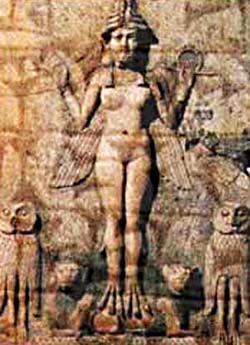
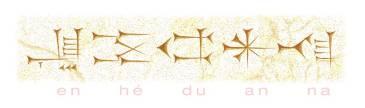
Enheduana


Enheduana /En-hedu-Ana/
The earliest female poet, the history  had known, She was the daughter of king Surgeon , in the city of Ur around 2354 B.C


she was the highest priestess in the temple of nana (Akadian moon God) so she was the only one who was able to name a new ruler to the city , more over the temple was a center of sciences  and observation of sky and stars . She hepled  her father to put the empire together by uniforming the worshipping pf Inana all over it. so she was prietess , poet and princess .. played many important-complex  roles in that ancient society  .

references : 
- about.com 


Leon Jerom , the french orientalist painter , had painted Enheduana as one circle of middle east touched chain of paintaings. 
her Iraqi beauty as we see, black lined eyes , black hiar and fair skin  are  tyrant and unbearable. 
the enviromant behinde her is typical for south iraqi regions. 
the ornaments she wears had been given a great deal of care by  Jerom.  

Friday, September 9, 2011

Proserperine & Jane Morris


My analyis : 
1- Ivy , represents eternty, life ,fidelity, love and freind ship, which may stands for the painter's feelings toward Jane( the model) 
2- pomegranate , for fertility or  as seen in the myth it represnts Pluto's  pomegranate from which Proserperine ate only 4 granules leaving six. 
3- her metalicous detailed (blue)  rob was a signal for stability and intelligence. 
4- The grief upon her face my stand for the model's ( Jane morris)- whom Danti Rosseti fell in love with- sadness  as she  was not happy in her marriage with the writer Wiliam Morris.
5- That thing with smoke I can't explain it till now *_* .
6- CERTAINLY, the painting has alot of meaning left , so maybe you help me figure it out :)

Tuesday, July 19, 2011

Sunday, July 17, 2011

Jean-Léon Gérôme


Jean-Léon Gérôme (11 May 1824 – 10 January 1904) was a French painter and sculptor in the style now known as Academicism. The range of his oeuvre included historical painting, Greek mythology, Orientalism, portraits and other subjects, bringing the Academic painting tradition to an artistic climax.


Jean-Léon Gérôme (11 May 1824 – 10 January 1904) was a French painter and sculptor in the style now known as Academicism. The range of his oeuvre included historical painting, Greek mythology, Orientalism, portraits and other subjects, bringing the Academic painting tradition to an artistic climax.

Monday, July 11, 2011

The student beats his master


Moment of interruption\ Bouguereau (the master)
 

Moment of inspiration \seniac(the student

I think seniac's vergion is more beautiful ,what do you think?

Judith

From WIKIPEDIA 
The account of the beheading of Holofernes by Judith is given in the deuterocanonical book of Judith, and is the subject of numerous depictions in painting and sculpture. In the story, Judith, a beautiful widow, is able to enter the tent of Holofernes, an Assyrian general who is about to destroy Judith's home, the city of Bethulia, because of his desire for her, though the story is emphatic that no "defilement" takes place. Overcome with drink, he passes out and is decapitated by Judith; his head is taken away in a basket (often depicted as carried by an elderly female servant). Artists have mainly chosen one of two possible scenes (with or without the servant): the decapitation, with Holofernes prone on the bed, or the heroine holding or carrying the head.

In European art, Judith is very often accompanied by her maid at her shoulder, which helps to distinguish her from Salome, who also carries her victim's head on a silver charger (plate). However, a Northern tradition developed whereby Judith had both a maid and a charger, famously taken by Erwin Panofsky as an example of the knowledge needed in the study of iconography. For many artists and scholars, Judith was a character whose sexualized femininity interestingly and sometimes contradictorily combined with her masculine aggression. Judith was one of the virtuous women whom Van Beverwijck mentioned in his published apology (1639) for the superiority of women to men,and a common example of the Power of Women iconographic theme in the Northern Renaissance.